But I don’t care. The other part of me, calls that part chicken-shit. The other, stubborn part of me wants me to finish what I started. The other, bullshitting part of me likes crap whose reason and meaning might be hidden from me, might be so hidden that I won't see it until I take my last breath, or maybe never, maybe it doesn't have any, and maybe its attraction and beauty is precisely the result of that very lack of reason and meaning. So that other part of me wants to show how stuff is put together, wants to show little pieces that might end up making the whole, wants to show how this record is different from other records we’ve done, wants to let the crap fly to the four winds, devil be damned, before it ends up in the cutting room floor. This other part of me sometimes hopes that when you hear the finished record, you’ll feel like you were part of its creation, feel like you heard the songs when they were merely a few chunks of undigested chords. But this other part of me, also thinks, to hell with it, this is what I’m doing, and who needs a reason for anything. Because this part of me likes to go on about nothing, constantly dwelling on nothing, constantly trying to make something out of nothing, constantly trying to find the little bit of something in all that nothing.
And if nothing else this series of posts should at least be a document of how our record was made, a document of how we made a record after having a baby during her first years, a document of music in transition. A document which maybe, just maybe, long after I'm gone, she'll read as she listens to the record and feel something special thinking that this record was all done for her.
Ok, so a few weeks back we picked up the recording after the holiday break and I put some guitars to substitute the scratch guitars that were there with the drum tracks. Not really too much to report from that session. But some days later Stu Cole put some bass tracks down. You’ve already heard his name mentioned on this blog, so let me tell you a little about Stu.
I’ll tell you a recent story because I think it conveys the spirit of the man when it comes to music. Last year, on Thursday November 1, I went to the Orange County Social Club (a bar in the town of Carrboro which is in Orange County NC) to have a drink after work, and I ran into Stu. He had been out late late for Halloween the night before and wasn’t fully recovered. We had a few drinks and an old friend of Stu’s who he hadn’t seen for some time showed up. I left them catching up in the back patio and went inside for drinks. I guess I took a bit longer than I thought because when I went back out, Stu had walked the five or so blocks to where his car was parked and had walked back with his stand-up bass, so that his buddy, who fetched his guitar from his car out back, and him could play a few songs sitting in the back of the OCSC. There was no one there but us three, so it wasn’t like a concert or anything of the kind. It was two buddies playing music together, playing bits of songs, helping each other remember old songs they’d played together, sharing new music they’d been working on, laughing, singing, playing and having a good time. I kept going inside to talk to the people at the bar and out to the patio to watch them play a song or two and back inside. Once in a while someone would hear the music and walk up and sit and listen for a bit, and then go on their way. It was all very casual and it went on for a good two hours.
Eventually Stu’s friend had to go. By then both Stu and I were fairly toasted, but Stu had the added weight of the previous night’s Halloween debauchery plus a stand-up bass to carry. I offered to walk with him to his car so we could drop off the bass and figure out what to do next. But the bass is a big instrument to carry drunk for five blocks. So we crossed the street with some difficulty and reached Southern Rail (aka The Trains), which at this point had been opened for just a month or two. We decided we needed a rest stop. After all, we had made it across the street from OCSC, so a reward was in order. As luck would have it, there just so happened to be an old-timey band about to start playing in the main platform/bar area of The Trains. These were four guys with no amplification at all, fiddle, banjo, mandolin and washboard. And in walks Stu with a stand-up bass he can barely carry.
Master songwriter Jim Smith, immediately spotted us, and comes up to Stu and will not take no for an answer, not that Stu was trying to get out of it. Jim carried Stu’s bass to where the four unsuspecting gentlemen were about to start playing, took the bass out of the case and held it up while he waited for Stu, who stumbled over to the bass and barely got behind it as the group started their set. It was like Popeye and spinach. Without missing a beat, Stu was on. It was hard to tell if he was holding the bass up or if the bass was holding him up, but there was no denying that he was rockin' that Brutus of a bass. And just to be sure, the old timey band, right away on the first song, threw him a solo, Stu handled it like the captain of a hundred stormy seas, and from then on the old-timey band was up and away riding a ship fueled by Stu and his bass.
After that the night got even crazier, but that is another story. What I’m trying to say here is that Stu is not only an incredible bass player, but also a musician with a true love for music. This is a player who’s in a band that (according to the wiki, anyway) had a platinum record, has been on all the late night shows, Sesame Street, the Olympics, president Clinton’s inaugural ball, you name it. But even with all that “success”, his real success is that he has remained true to the music. And he is never too tired to play or record with a friend.
Originally we were going to record at Stu’s little farm cabin studio, but the studio had to be shut down. I still wanted Stu to be part of the project so I asked him if he would play some bass on the record and he readily agreed.
We set up a date with Jesse Olley, who is co-producing and engineering the record, and I gave Stu a CD with what we had, which was drums and guitars with some scratch vocals. After that I met with him three or four times. Each time we sat and listened to the tracks, and talked about them, and he would play little bits on whatever instrument was available. And I would respond and we would listen some more and talk some more. We did a lot more talking than playing and we never played the songs all the way through from beginning to end. The night before the session, I was nervous. I’ve heard Stu play many times, and I’ve heard his recordings, so I trusted him, but I hadn’t heard him play any of the songs we were going to record from beginning to end, and this way of recording one instrument at a time is still new to me, so I was nervous.
The recording day arrived and we went to Jesse’s Ultra Fin Riz Studio. We had a five hour session ahead of us and about 10 songs/parts of songs to work on. The plan was to do as much as possible and then come back another day to finish. We decided to do the electric bass parts first since those were the majority, and Stu suggested a direct line and then just punch and run. Jesse and I must be from the same school that doesn’t trust direct lines too much, so we ran the bass direct and through different amps, but the direct line always sounded best. So we went with that, and then Stu proceeded to lay down 9 of the 10 songs we were working on, in one of the smoothest sessions I’ve ever participated in. We did not get the full impact of Stu's playing as I've seen it on stage, ripping it up like some rock god, instead Stu put solid bass parts that enhance the songs without drawing attention to themselves. They were the perfect bass parts for this record. And besides that, I got a master recording lesson.
There were a couple of factors that made this session such a success, aside from Stu’s expertise. The first was the punch and run method, which was a definite eye opener for me. The second was the importance of talking about the music and developing an understanding about it. As Stu laid down the bass parts, I realized that during the hours we had spent talking about the tracks we had developed a clear way of talking about the music much like the way that bandmates sometimes can. Understanding was the main obstacle, and once we understood each other the act of translating that understanding into music was actually fairly simple, at least when working with someone as skilled as Stu.
The way the session went was pretty much like this: Jesse would start recording and Stu would play the song up to a good stopping point, he would then ask me what I thought of that, and I’d say something like, maybe you can flip that last turnaround upside down, loosen it up a bit and come in on the three with that buddy holly bit, except make it more clouds and rain but add some Jupiter to it, and he knew exactly what I meant! And not only that, he would adjust accordingly, replay the part up to the break, stop, how was that? Perfect, I'd say. Ok, let’s keep going. Jesse would punch in there, and we’d move forward along the track, punching and running, sometimes back tracking a bit and redoing a section, until we’d get to the end. Then we would listen to the whole thing, and maybe do it one more time depending on how we felt about what we had. Sometimes we redid a beginning only, or a middle part, but for the most part it ran seamlessly, and for the most part when we got to the end of the track, it was done.
One is never to old to learn new tricks and this session taught me a few things. I had more than a few preconceptions blown away: that you have to know the song beginning to end to be able to record it, that recording with a direct box is not a good idea, that it’s better to be standing up when you record, that punching in is only for correcting mistakes, that one should play the song beginning to end like one would if it was a live performance. These are all preconceptions I’ve had from years of recording music as if it was live, from years of trying to capture in the studio what a band’s perfect live performance might be like, because all those things apply if you are playing live. But if one does away with the idea that a recording should somehow document what a band can do live, then one can judge a recording as just music. I'm sure all this is no news to many, and though I knew it in theory, this is the first record that I feel I've been putting that to practice. And while some purist part of me wants to call it cheating, the other part of me is quickly learning to call it recording.
Now, here’s a couple of tracks that are more traditional songs
First, here’s Stayed and Gone which I think you’ve now heard at various stages. This is just one guitar, drums, electric bass… still to be added is other stuff like vocals, trumpet and pedal steel.
And here’s Season of the Grape which you’ve also heard at a few stages along the way. This again is one guitar, drums and stand-up bass, which was recorded with some heavy duty mikes in an isolation booth, but still using the punch and run method.
Finally, here’s the first minute from Always Home, which includes a new intro, which used to be a separate bit called An Attempt, which was originally recorded as a segment for the NAP’s exquisite corpse experiment many months ago. That bit is now integrated into the song, at least by Garageband standards. Many of these more abstract bits such as An Attempt, which were recorded on Garageband are being slowly transferred to the masters at Jesse’s studio and re-mixed and re-edited for the record, but keeping the actual tracks.
**************
Se Acabaron las Navidades
Christmas is over in Puerto Rico. This Saturday, February 2nd, Dia de la Candelaria (Candlestick Day), everyone will take their dried up x-mas trees to the beach and burn them in huge bonfires.
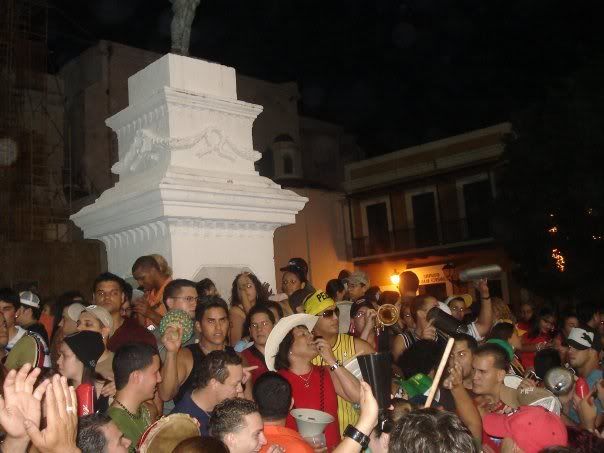
The weekend before last was the official last party of the season with Las Fiestas de la Calle San Sebastian. These Fiestas have grown from a little street fest for the local residents of Old San Juan into a massive festival with lots of corporate sponsors and the idiots that go along with the corporate sponsorship. I’m not sure how I would feel about going to them if I was there, but even so, I see from the picture below, that Billy Van is still going, so I think ultimately I would have to say, that if it is still good enough for Billy Van, it’s still good enough for me. Billy Van has developed over the past 20 or 30 years into a sort street leader for the fiestas, organizing random groups of singers and musicians, and leading them through the streets. Here’s a picture of Billy Van in action by the Ponce de Leon statue in the Placita de San Jose, with his trademark hat and megaphone. This is one huge parranda. Can you find all the instruments in the picture?